Your stick is an extension of you.
Sure there are others like it, but you're holding the only one that matters. Best have a stick that reflects who you are and how you want to play the game.
With that in mind, Krunk Hockey offers a wide variety of functional and cosmetic options. So much so that it can understandably be a bit confusing and overwhelming. Below you'll find easy explanations for each option and how they apply to your stick. Keep in mind the Blade Patterns are on a different page.
And of course if you have any questions, feel free to reach out to us at Service@KrunkHockey.com.
Customization Options
Flex Rating
Stick "flex" measures the exact amount of force, in pounds, required to bend the center of a one-meter shaft by exactly one inch. For example, if a stick has an 85 flex, it takes 85 pounds of downward force to deflect the shaft one inch.
The purpose of flex is to basically load up and release kinetic energy from the stick into the puck. When a player leans into a shot, the shaft bends and stores energy. When the blade strikes the puck and the shaft snaps back straight, that stored energy is released, acting as a slingshot to propel the puck forward. Choosing the right flex ensures a player can efficiently load the stick using their specific body weight and strength.
Cutting the stick can have an effect too. The flex rating increases about 3-5 for every inch cut off the stick.
"Whippy" - (55 to 75 flex rating - Sr. Sticks)
Pros:
-
Effortless Loading: Requires minimal strength and weight to bend, making it easy to activate the "whip" of the stick.
-
Lightning-Quick Release: Perfect for snapshots in tight spaces or shooting off the wrong foot where you don't have time to fully transfer your weight.
-
Less Physical Fatigue: You don't have to fight the stick to get velocity on your wrist shots.
Cons:
-
The "Noodle" Effect: Can feel too soft or unstable when receiving hard, heavy passes, causing the puck to bounce over the blade.
-
Weak Slap Shots: Heavy shooters will easily over-flex a whippy stick, causing the blade to open up, fluttering the puck or bleeding power.
-
Durability in the Trenches: More prone to snapping during heavy board battles, slash-downs, and faceoffs.
"Stiff" - (90 to 125+ - Sr. Sticks)
Pros:
-
Maximum Slap Shot Power: If you have the strength and mass to bend a stiff stick, the energy return on big clappers and one-timers is massive.
-
Rock Solid Stability: Great for digging pucks out of the corners, tying up sticks in front of the net, and winning heavy faceoffs.
-
Pass Reception: The stiffness absorbs heavy passes cleanly without the shaft buckling backwards.
Cons:
- Hard to Load: If a player doesn't have the size or mechanics to bend it, the stick essentially acts like a piece of rebar, hurting shot velocity.
-
Slower Release: Snapshots and wrist shots take more physical effort and a longer weight transfer to execute with power.
-
Harsh Feedback: Hitting the ice heavy without actually flexing the stick sends a lot of shock directly up into the hands and wrists.
Kick Point
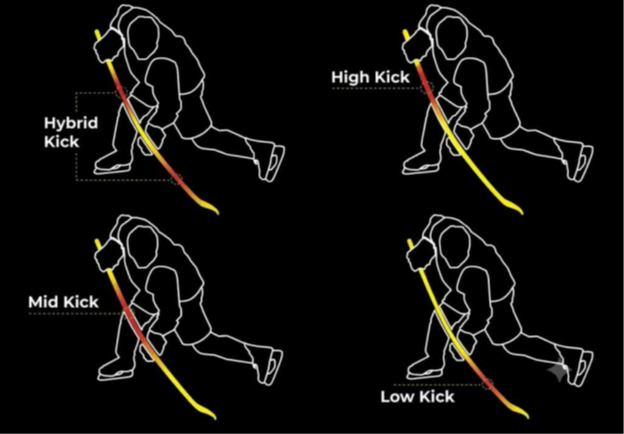
The Kick Point is the specific zone on the shaft that is engineered to bend the most when a player leans into a shot. Changing where the stick bends changes how the puck comes off the blade, dictating whether the stick prioritizes a lightning-fast release or maximum sheer power.
Here is the breakdown of the four main kick point profiles.
Low Kick Point
Profile: The shaft is engineered to bend down near the hosel, just above the blade.
-
Pros: It offers the fastest release in hockey. Because the bend happens so close to the puck, the energy travels a very short distance, allowing the stick to snap back into place almost instantly.
-
Cons: You sacrifice top-end shot velocity. Since you are only bending the bottom quarter of the shaft, you aren't storing as much total potential energy as you would by bowing the entire stick.
-
Best Usage: Snipers, playmakers in traffic, and players who rely on quick snapshots, rapid wrist shots, and getting the puck off their blade before the goalie can set.
Mid Kick Point
Profile: The stick bends right in the middle of the shaft, typically right around where the player places their bottom hand.
-
Pros: It provides maximum energy transfer and pure power. Bending the center of the shaft turns the stick into a massive bow, storing a huge amount of kinetic energy that unleashes violently when the stick straightens out.
-
Cons: The release is slower. It takes a fraction of a second longer to mechanically load the center of the shaft and for that energy to travel down to the blade.
-
Best Usage: Heavy shooters, defensemen, and players who love taking massive slap shots, heavy one-timers, and full-windup wrist shots from the circles or the blue line.
High Kick Point
Profile: The bend occurs higher up the shaft, closer to the top hand.
-
Pros: Generates the heaviest, most overpowering shots possible. By moving the flex point up, the entire lower two-thirds of the stick acts as a long, stiff lever that whips through the puck with incredible force.
-
Cons: It features an extremely slow release and demands a lot of physical strength, weight, and time to load properly. It will feel incredibly stiff and dead on quick, in-tight shots.
-
Best Usage: Pure slap-shot specialists and defensemen who have the time and space at the point to step into a massive shot.
Hybrid (Variable) Kick Point
Profile: The stick is engineered with multiple stiffness zones, allowing it to adapt its flex point based on where the player positions their bottom hand.
-
Pros: It is the ultimate "jack of all trades." If you slide your hand down for a heavy slap shot, the stick reacts by flexing higher up. If you keep your hands closer together for a quick snapshot, it flexes lower. It provides a highly versatile, adaptable shooting experience.
-
Cons: It doesn't specialize. While it is good at everything, it won't give you the absolute fastest release of a true low kick, nor will it give you the pure, unadulterated power of a true mid kick.
-
Best Usage: Versatile, all-around players who take a wide variety of shots depending on the situation and want a stick that dynamically adapts to the play.
Shaft Dimensions
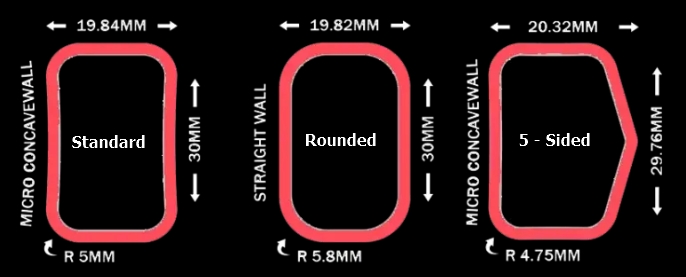
The Dimensions and shape of a stick's shaft dictate how it sits in your hands, affecting both your grip security and how freely you can roll your wrists.
Standard Shaft (5mm Corner Radius)
Profile: Traditional square corners (with a tight 5mm radius) and slightly concave sidewalls. This is the classic, time-tested hockey stick shape.
-
Pros: Unmatched grip security and stability. The pronounced corners provide a highly tactile surface for your fingers to wrap around and lock into. This prevents the stick from twisting or torquing in your hands when you lean heavily into a slap shot or receive a blistering pass.
-
Cons: The "boxy" feel can be slightly restrictive. The sharp corners can cause a bit of friction in the palms when trying to rapidly roll your wrists back and forth for quick puck handling.
-
Best Usage: Power shooters, defensemen, and players who prioritize a firm, locked-in grip and absolute shot stability.
Rounded Shaft (6mm Corner Radius)
Profile: Softer, thicker rounded corners (6mm radius) that take the sharp edges off the traditional rectangle. It typically feels slightly smaller or more contoured in the hand.
-
Pros: Supreme mobility and comfort. The rounded edges act like a smooth pivot point in your bottom hand, making it incredibly easy and fluid to roll your wrists for rapid stickhandling, toe drags, and quick puck manipulations.
-
Cons: Because the corners are rounder, there is less physical material preventing the stick from rotating. If you don't have a vice-like grip, the blade is more prone to twisting open on heavy slap shots or during intense board battles.
-
Best Usage: Playmakers, elite stickhandlers, and players who rely on quick, fluid wrist movements and dangling rather than pure shot power.
5-Sided Shaft ("Nexus")
Profile: A highly engineered pentagonal (five-sided) shape. Instead of a flat backwall, the back of the shaft converges into a protruding "spine," removing the two traditional back corners entirely.
-
Pros: Ergonomic perfection. When you close your hand, your palm naturally forms a curved pocket—the 5-sided spine is designed to fill that contour. Furthermore, removing the excess carbon fiber from those back corners actually makes the stick slightly lighter and easier to flex, enhancing the loading process of the stick.
-
Cons: It is a very distinct, non-traditional feel. Players who have spent 20 years playing with standard rectangular shafts often find the spine shape distracting or strange when sliding their bottom hand up and down the stick.
-
Best Usage: Players looking for a naturally ergonomic fit, shooters who want the shaft to load with slightly less effort, and anyone who feels standard shafts are too bulky.
Shaft Texture
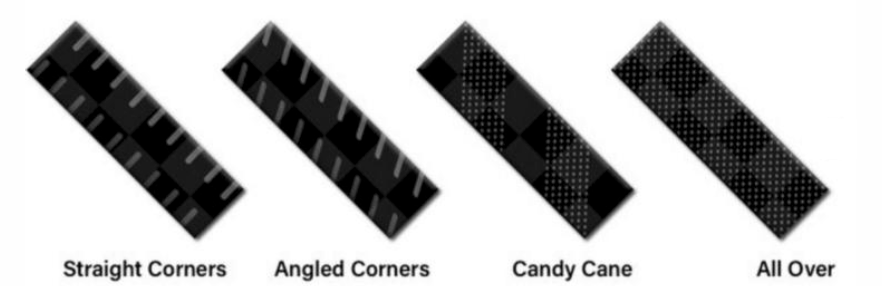
Raised Textures on the stick for further control. Not pictured above is the Fish Bone style (similar to Angled Corners, but with more varying pattern). There textures are on the entire shift of the stick. Straight Corners, Angled Corners, and Fish Bone are on the corners exclusively.
Shaft Finish
The Finish of your shaft has both a cosmetic and functional element.
- Glossy Grip: Standard grip surface found on most retail sticks.
- Matte Grip: A kind of hard rubber grip, but less than Glossy
- Glossy (No Grip): Clear varnish coating No grip coating in the traditional sense, but more grip than Matte
- Matte (No Grip): Without any coating. The smoothest option. A flat
- Super-Glossy Grip: Similar to Glossy, but with a more luminous finish.
Stick Weave Appearance
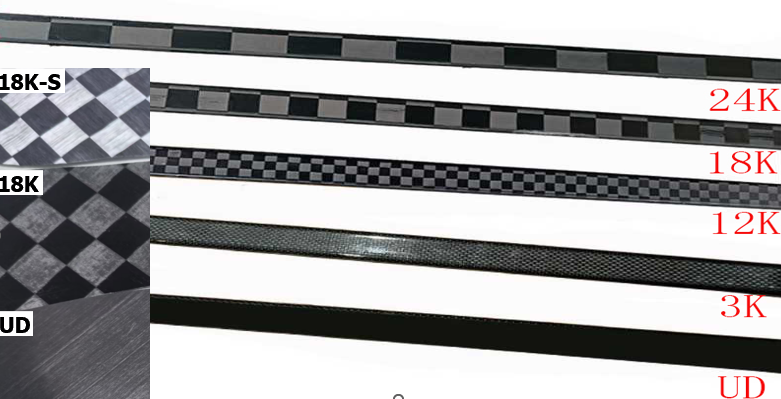
Your stick should look as elite as it plays. That’s why you get complete control over the final visual layer of your custom carbon fiber setup. Choose from five distinct exterior finishes to match your exact style on the ice. Go bold and aggressive with the large, unmistakable checkerboard patterns of the 24K, 18K, or 18K-Silver weaves. Keep it classic and dialed-in with the tighter, traditional high-performance look of a 12K or 3K carbon wrap. Or, if you prefer a sleek, stealthy, "all-business" vibe, opt for the smooth, solid-black finish of our UD (Unidirectional) carbon.
* Note that 5-sided shafts with 3K or 12K finishes add roughly 15g-30g to the stick weight. The variance applies only to these specific configurations.
Color
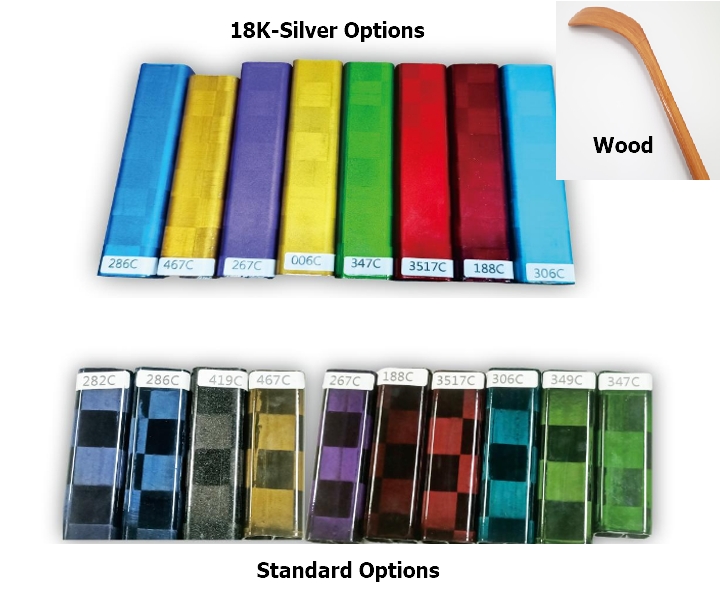
Your game is unique, and your stick should be too. With a massive lineup of 18 different custom shaft colors, you have the ultimate freedom to build a stick that perfectly matches your team’s sweater, reps your personal brand, or just stands out under the arena lights. Whether you want to keep it classic with a deep blue or gray, make a statement with a vibrant pop of crimson, teal, or kelly green, or even go old-school with a retro wood-grain finish, Krunk Hockey lets you leave the generic retail designs behind. It’s your setup—paint it your way.
Blade Texture
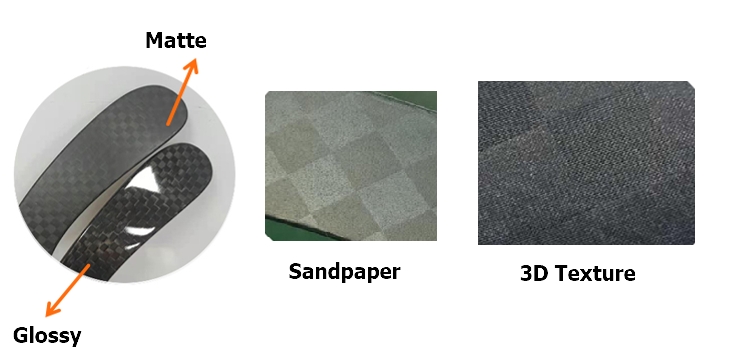
Finish Strong at the Point of Contact. How your blade interacts with the puck—and your tape—is all about personal preference. That’s why we offer four distinct blade finishes to complete your custom build. Whatever your hands demand, we've got the finish to match.
.
Extension
Extend Your Reach. Tired of messing with wooden end plugs just to get your stick to the right height? For taller players or defensemen looking for that extra sweep check radius, we offer up to 6 inches of factory stick extension. Instead of altering your stick's natural kick point and balance with an aftermarket plug, your custom Krunk stick is manufactured exactly to your required length right from the start. Get the perfect leverage, maximum reach, and a seamless feel without compromising an ounce of performance.
Reminder that Krunk Sticks are 65 inches tall from toe to end with the stick plumb.
A Quick Note on Flex: Remember that cutting a stick down makes it stiffer, and adding an extension makes it whippier. As a general rule, cutting one inch off the shaft will increase the stick's flex rating by about 3 to 5 points.
Goal Stick Specific Options
Shoulder Shape
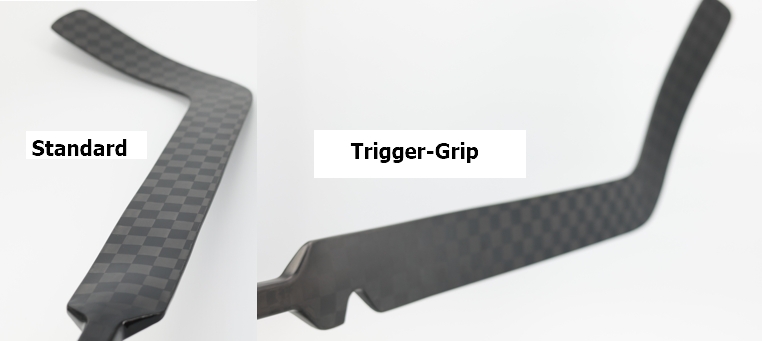
The Transition from the shaft to the paddle—the shoulder of the stick—is the primary connection point between you and your gear. We offer two distinct shoulder profiles to match how you naturally handle the puck and absorb heavy shots.
Stick with the Regular shoulder for a classic, smooth contour that allows your hand to slide effortlessly up the shaft for sudden poke checks and quick puck handling out of the trapezoid. Or, upgrade to the Trigger Grip, which features an ergonomic finger cut-out engineered to lock your index finger right into the top of the paddle. This specialized notch provides unprecedented tactical control, perfectly aligns your blade to the ice, and completely eliminates stick torque when deflecting heavy shots away from the net.
Paddle Length
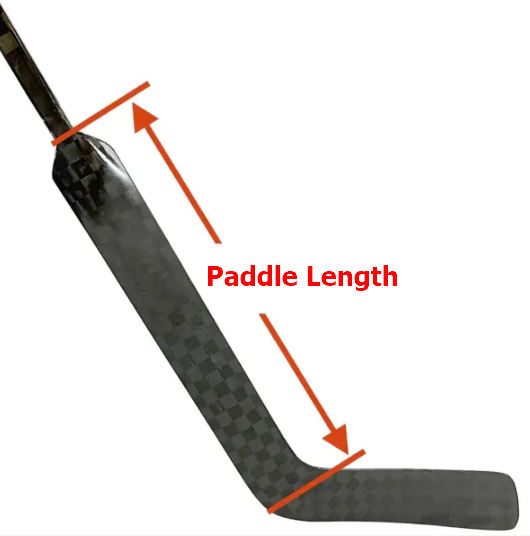
Every Goalie's stance depth and arm length will ultimately dictate their perfect fit, here is a standard industry baseline to help point you in the right direction based on overall height:
General Paddle Sizing Guide
| Goalie Height | Suggested Paddle Length |
| Under 5'0" | 21" – 22" (Youth / Junior) |
| 5'0" – 5'4" | 23" – 24" (Intermediate) |
| 5'5" – 5'8" | 25" (Senior) |
| 5'9" – 6'0" | 26" (Senior) |
| 6'1" – 6'3" | 27" (Senior) |
| 6'4" and taller | 28" or custom (Senior) |
A Quick Pro-Tip for Sizing:
Modern butterfly goalies typically lean toward a shorter paddle. Dropping down a size (for example, a 6'0" goalie choosing a 25" instead of a 26") helps keep the blocker tighter to the torso and ensures the entire blade stays completely flush against the ice when down in the butterfly. If the heel of the stick is lifting off the ice when in the butterfly, the paddle is too long.
Shoulder Finish
Your Blocker hand needs to react instantly, whether that means locking down for a heavy shot or sliding up the shaft to play the puck. We offer distinct finishes for the shoulder zone to match your specific crease movements.
Choose a standard Matte or Gloss with No Grip if you want zero friction, allowing your hand to slide effortlessly up the shaft for sweeping poke checks and quick puck handling out of the corners. If you prioritize absolute stability, opt for one of our Grip Finishes. This applies a specialized, tacky coating specifically to the shoulder area, ensuring your hand stays completely locked into your stance and preventing the stick from twisting when you take a heavy clapper directly off the paddle.
- Glossy Grip: Standard grip surface found on most retail sticks.
- Matte Grip: A kind of hard rubber grip, but less than Glossy
- Glossy (No Grip): Clear varnish coating No grip coating in the traditional sense, but more grip than Matte
- Matte (No Grip): Without any coating. The smoothest option. A flat
- Super-Glossy Grip: Similar to Glossy, but with a more luminous finish.